.png)

AWS published a post on multi-agent social intelligence with Strands Agents and Amazon Bedrock AgentCore, showing how Thrad.ai automated prospect research and personalized outreach across six public sources. The core idea is straightforward: one signal is usually noise, but correlated signals across Reddit, Hacker News, Stack Overflow, GitHub, and other sources can identify high-intent prospects before sales touches them.
Thrad.ai’s workflow is a good example of where single-agent setups break down in production. The inputs are heterogeneous, the retrieval surfaces are inconsistent, and the reasoning is not uniform across sources. A GitHub repository with a fast star ramp, a Stack Overflow question spike, and a founder’s post in a niche subreddit are different modalities of intent. Forcing one agent to do collection, normalization, ranking, interpretation, and email generation usually produces brittle prompts and shallow analysis.
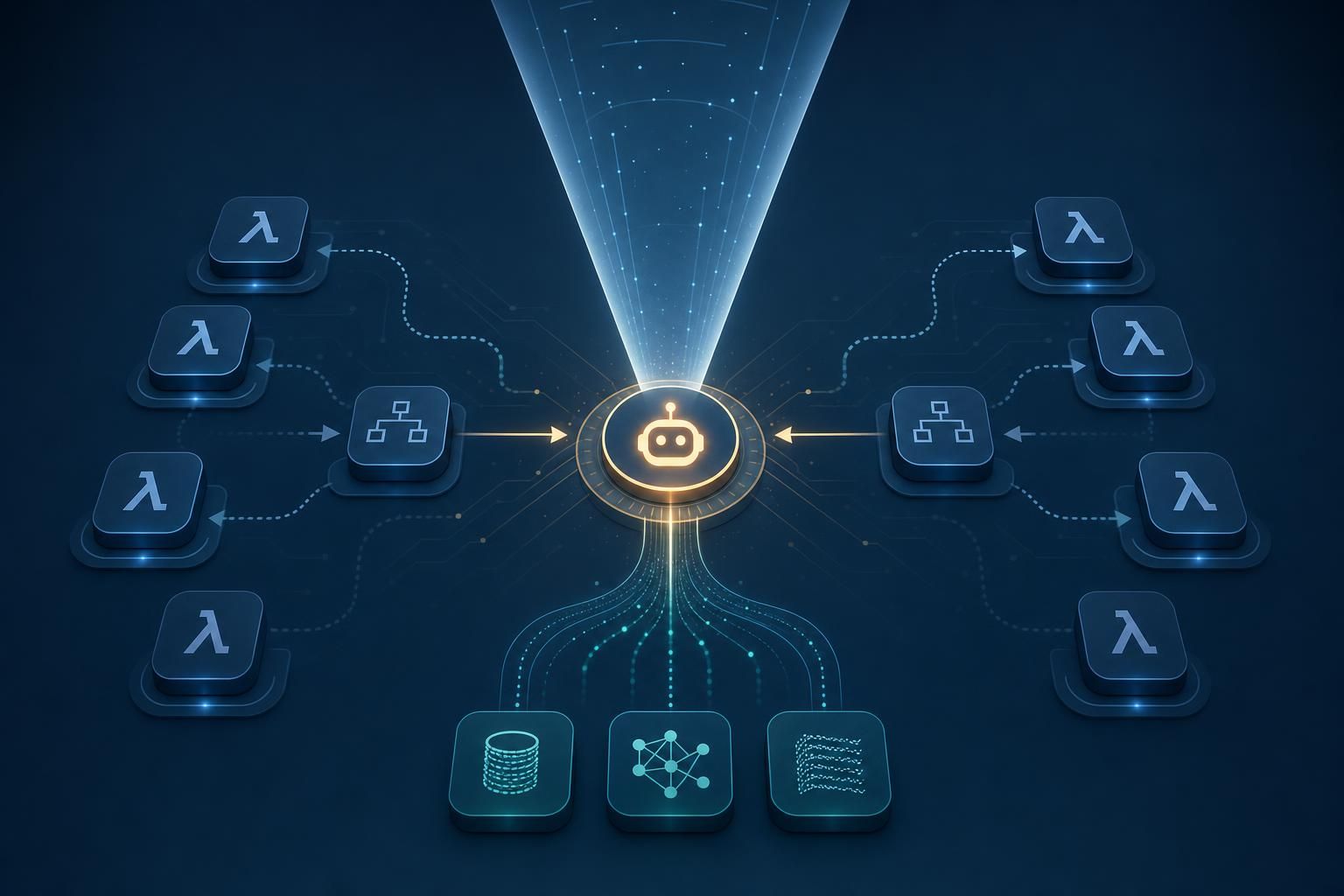
The architecture AWS describes splits the problem into specialists. Each agent owns one source or one analysis step, then a downstream agent fuses the outputs into a prospect view. That decomposition is the right instinct for production systems because it localizes failure modes. If one connector rate-limits or one source changes schema, only that agent degrades. If the synthesis step is wrong, you can inspect the per-source evidence instead of debugging a monolith.
That matters more than it sounds. In sales and market-intel workflows, the value is not raw retrieval; it is the confidence that the final recommendation is backed by traceable evidence. Multi-agent structure makes that evidence easier to preserve.
The post compares two orchestration patterns in Strands Agents: Swarm and Graph. That comparison is the most useful part of the write-up because it maps cleanly to how I would think about production tradeoffs.
Swarm-style orchestration works when you want dynamic task routing and opportunistic coordination among agents. It is attractive when the set of signals is variable, the order of inspection is not fixed, or you want the system to decide which specialist should inspect which lead. It tends to reduce wiring overhead and can be a good fit when source coverage changes frequently.
Graph orchestration is the safer choice when the workflow is stable and the dependencies are known. In this use case, source collection, scoring, cross-source analysis, and email drafting form a natural DAG. Graphs are easier to reason about, easier to observe, and usually easier to cost-model. If I were running this in production, I would default to Graph for the core pipeline and reserve Swarm for exploratory or exception-handling paths.
The benchmark framing in the post is also the right one: latency, cost, and email quality should be measured together. Optimizing only for speed in an outreach system is a mistake if the result is generic copy. Optimizing only for quality can quietly make the unit economics unusable. In systems like this, throughput is a product requirement, not an implementation detail.
Thrad.ai’s scoring model combines weighted criteria, intent classification, and temporal decay. That combination is what turns a feed of noisy mentions into something sales can actually use.
Weighted criteria let the team encode business judgment: a launch announcement may matter more than a casual comment, a repository star burst may matter more if the repo is adjacent to their product category, and a direct product question in a community forum may be more actionable than a generic discussion thread. Intent classification adds another layer by separating curiosity from purchase intent. Temporal decay keeps the score aligned with recency, which is critical because stale signals are often misleading in fast-moving categories.
I would expect this to outperform a pure embedding-similarity approach for lead ranking because it preserves semantics that matter operationally: recency, source reliability, and intent strength. It is also easier to tune with human feedback. Sales teams can usually tell you why a lead felt hot or cold; a system with explicit weights and decay terms can absorb that feedback without retraining a black-box ranker.
The important design constraint is calibration. If the score is used to prioritize outreach, the threshold should be tied to observed conversion or response rates, not just arbitrary numeric scale. Otherwise the system will drift into producing more leads than the team can act on, which defeats the point.
The post also calls out governance controls for production deployment, which is where most multi-agent demos usually stop being useful. Once you automate lead generation and outbound drafting, you need controls around tool access, data handling, and agent behavior. A system that scrapes public sources and drafts sales messages can still create operational risk if it over-collects, hallucinates evidence, or sends inconsistent messaging.
Bedrock AgentCore is positioned as the deployment layer for those controls. For an implementation like this, I would look for three things before approving it for real use: auditability of each agent action, separation between collection and generation privileges, and the ability to block or review low-confidence outputs before they reach a human. In practice, that means the prospecting agents should not have the same permissions as the email-generation agent, and the analysis stage should emit structured evidence rather than just prose.
That separation also makes evaluation much easier. You can test source agents for extraction quality, the analysis agent for ranking fidelity, and the drafting agent for tone and personalization quality independently. If everything is fused into one model invocation, you lose the ability to tell whether bad outreach came from poor signal collection or poor synthesis.
The companion repository is useful for teams that want to adapt the pattern to competitive intelligence, candidate sourcing, or market research. The broader lesson is not “use more agents”; it is “assign clear responsibilities, preserve evidence across steps, and measure the orchestration layer as a first-class production system.”