.png)

NVIDIA and LangChain released a tuned Deep Agents harness for NVIDIA Nemotron 3 Ultra, with NVIDIA claiming benchmark-leading results on LangChain’s Deep Agents benchmark. The important part is not a new model: the gains came from changing the agent environment around Nemotron 3 Ultra, not retraining the weights.
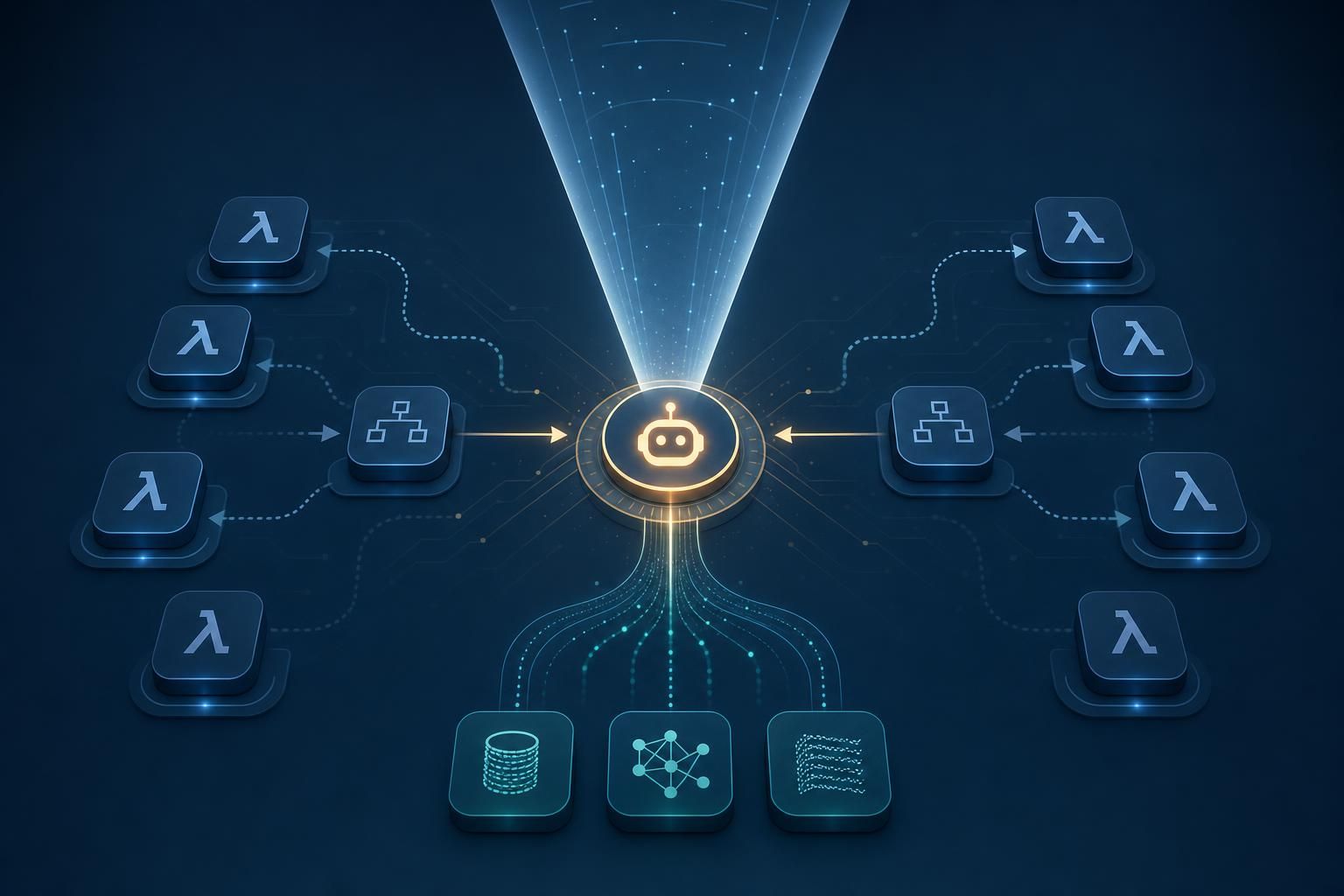
LangChain’s Deep Agents is an open-source harness for long-running, multi-step agent tasks. NVIDIA tuned that harness specifically for Nemotron 3 Ultra and reports three outcomes that matter operationally: highest accuracy among open models, more tasks completed at higher throughput, and roughly 10x lower inference cost per run than leading closed models.
That framing is the real story. If the benchmark results hold up under your workload, this is a strong example of system-level optimization outperforming model churn. For teams already spending time on prompts, tool schemas, retries, memory policies, and evaluation loops, the release says those knobs are enough to move the needle materially without touching training.
The cost claim is especially important for agent programs that run evaluations continuously or fan out across many business workflows. At a tenth of the cost, you can afford more regression testing, more traffic shaping experiments, and more specialized agents per domain. That changes iteration speed more than a small bump in benchmark score does.
NVIDIA also says Nemotron 3 Ultra reached parity with the highest-scoring closed models on LangChain’s Deep Agents benchmark for business tasks. That places the model in a useful category for production teams: not just “best open model,” but “open model that can sit in the same conversation as top closed models when wrapped in the right agent stack.”
The qualifier matters. This is benchmark parity on a specific harness, not a blanket statement about all agent workloads. If your tasks depend heavily on tool reliability, state management, or long-horizon planning, the surrounding agent policy likely matters as much as the model. That is exactly why this release is interesting: it suggests there is still meaningful headroom in orchestration.
For enterprise buyers, the open-stack angle is as important as the score. Being able to customize, own, and run the full system anywhere is a practical advantage when agents touch sensitive workflows, internal systems, or regulated data paths. It also lowers dependency on a single vendor’s runtime behavior.
The release reinforces a direction many teams are already seeing in production: agent quality is increasingly a property of the whole system, not just the base model. Memory policies, tool routing, evaluation feedback, and behavior constraints compound when tuned together. LangChain’s CEO Harrison Chase made that point directly, and NVIDIA’s result is a concrete validation of it.
For engineers, the immediate implication is to treat harness design as a first-class optimization surface. If you are benchmarking an agent, do not stop at model choice. Measure task completion rate, latency distribution, retries, tool-call correctness, and cost per successful run under the exact orchestration layer you plan to ship.
I would read this release as a signal to invest more in environment tuning before jumping to fine-tuning. If your use case is multi-step and tool-heavy, the highest leverage may still be in: - tool selection and argument formatting - memory scope and retention rules - run-time evaluation and early stopping - planner/worker separation - refusal and fallback policies
That is where a lot of the production gain is hiding, and this announcement is unusually explicit about it.
NVIDIA says Abridge, Amdocs, and Box are embedding specialized agents into their platforms, while EY is expanding implementation capabilities around NVIDIA NemoClaw blueprints for LangChain Deep Agents. The pattern here is familiar: platform teams want a controlled, open stack, and integrators want repeatable blueprints they can adapt across clients.
That makes sense if you are deploying agents into business-critical workflows. The winning setup is rarely a single general-purpose assistant. It is usually a family of specialized agents with tightly scoped tools, defined evaluation gates, and governance around what they can read, write, and trigger.
The release does not give enough detail to evaluate the exact tuning strategy, benchmark methodology, or failure modes. But the headline is clear: LangChain and NVIDIA are betting that enterprises can get near-frontier agent performance by optimizing the system around an open model, and this result is meant to show that the cost-performance curve is now favorable enough to build on.