.png)

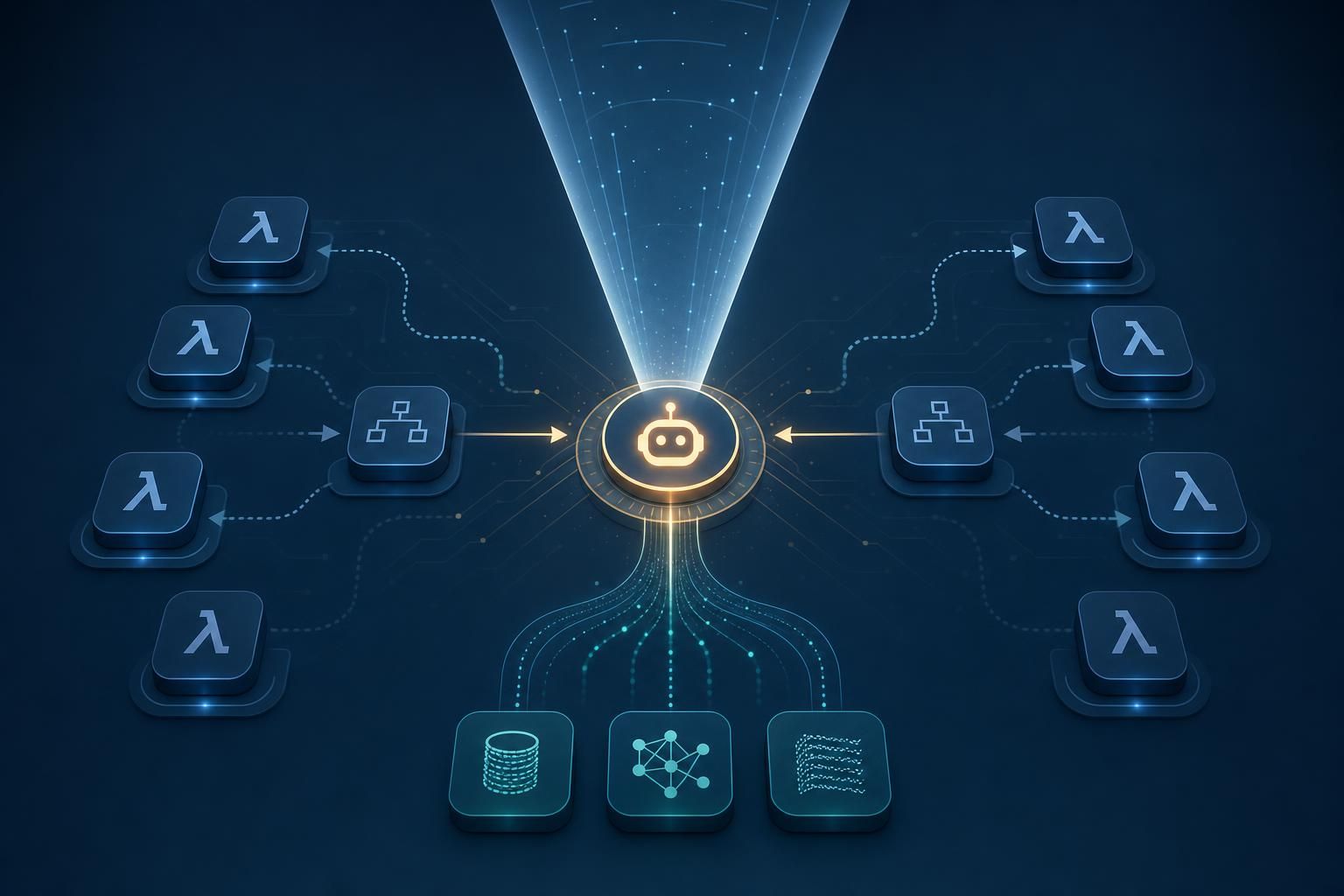
AWS released Strands Robots, an open source SDK that wraps robot abstractions, simulation, and the LeRobot stack as AgentTools for a single Strands agent. The integration is intentionally thin: LeRobot still owns hardware recording and calibration, while Strands handles orchestration across simulation, policy inference, and fleet coordination.
The interesting part is not that this is “an agent for robots.” It is that the SDK tries to remove the seams between the steps ML engineers already end up stitching together manually: collect demonstrations, train or select a policy, validate in simulation, deploy on hardware, and coordinate across multiple robots.
Strands Robots keeps the dataset contract anchored to LeRobotDataset, which matters more than the agent wrapper. If the same data format is produced in simulation and on hardware, you avoid a common failure mode where training, validation, and deployment each drift into slightly incompatible schemas or control assumptions. The agent loop becomes glue around a stable robotics interface instead of a new platform with its own artifacts.
The announced sample application walks through exactly that flow in one code path: build the agent over LeRobot AgentTools, record a demonstration in simulation, run a policy on the same robot, switch to a physical SO-101 with a single keyword argument change, and broadcast commands to a fleet over Zenoh mesh. For the default path, it runs locally in simulation with no hardware, GPU, or Hugging Face credentials required.
The most important design choice here is what Strands Robots does not replace. It does not reimplement hardware recording or calibration. Those remain LeRobot responsibilities, which keeps the SDK aligned with the existing Hugging Face robotics workflow and reduces the amount of “new robotics system” tax an engineer has to pay.
That separation is useful in practice. Hardware calibration is one of the places where abstractions tend to leak: joint offsets, zero positions, sensor alignment, and device-specific control quirks are all real concerns, and LeRobot already provides support for saving and loading calibration data automatically. Strands can orchestrate around that state, but it should not become the owner of it.
The same applies to the policy path. GR00T and LerobotLocal are exposed behind a common interface, and MolmoAct2 checkpoints run through the LerobotLocal path. That suggests the SDK is optimizing for interchangeability at the orchestration layer rather than inventing a new inference runtime. For an engineer evaluating this stack, the question is whether the common interface is thin enough that existing policies can slot in without special-casing, and whether any hidden assumptions emerge once you move from simulation to an actual robot.
The practical value of this release is that the same agent definition can execute in multiple environments with minimal branching. In the default configuration, the sample runs in simulation on a laptop. With a small configuration change, the same code targets a physical robot.
That matters because robotics teams often end up maintaining separate paths for: - data collection - offline playback - simulator evaluation - hardware execution - fleet coordination
Once those paths diverge, changes to observation structure, action scaling, or task logic become expensive to validate everywhere. A shared agent boundary does not eliminate the underlying complexity, but it does centralize it.
The claim worth testing is not “one codebase for everything,” because that is usually marketing language. The claim worth testing is whether the SDK preserves the important environment-specific constraints without forcing you to fork the control logic. If the only environment switch is a configuration parameter and the dataset and policy interfaces stay stable, that is genuinely valuable.
The Zenoh mesh integration is the part that turns this from a single-robot demo into something closer to a robotics control plane. The agent can fan out to remote robots through a peer mesh, which means multi-robot coordination is treated as a first-class transport concern rather than a separate distributed systems project.
That is a meaningful architectural choice, especially for teams that want a small number of orchestration primitives instead of building ad hoc RPC, pub/sub, or task dispatch layers around each robot. In practice, fleet behavior becomes easier to reason about when the same agent logic can address both a local simulator and a remote robot over the same abstraction boundary.
The unresolved question is operational maturity. Mesh-based control is attractive, but anyone deploying it at scale will still want to validate latency, failure handling, command ordering, and observability under real network conditions. The announcement does not provide those details, so I would treat the mesh as promising infrastructure, not as proof that fleet operations are solved.
The sample code is already available in examples/lerobot/hub_to_hardware.py, with a companion notebook in hub_to_hardware.ipynb. For teams already using LeRobot, the release is worth a close look because it preserves existing artifacts and calibration flows while adding an orchestration layer that spans simulation, hardware, and multi-robot control without forcing a format migration.