.png)

Couchbase published a production architecture for Capella iQ built on Amazon Bedrock, with Anthropic Claude as a foundation-model backend. The interesting part is not “LLM in the app” but the control plane: Couchbase moved to a model-agnostic, multi-Region inference design to absorb traffic bursts, preserve high availability, and let tenants or orgs choose model vendors without reworking the application.
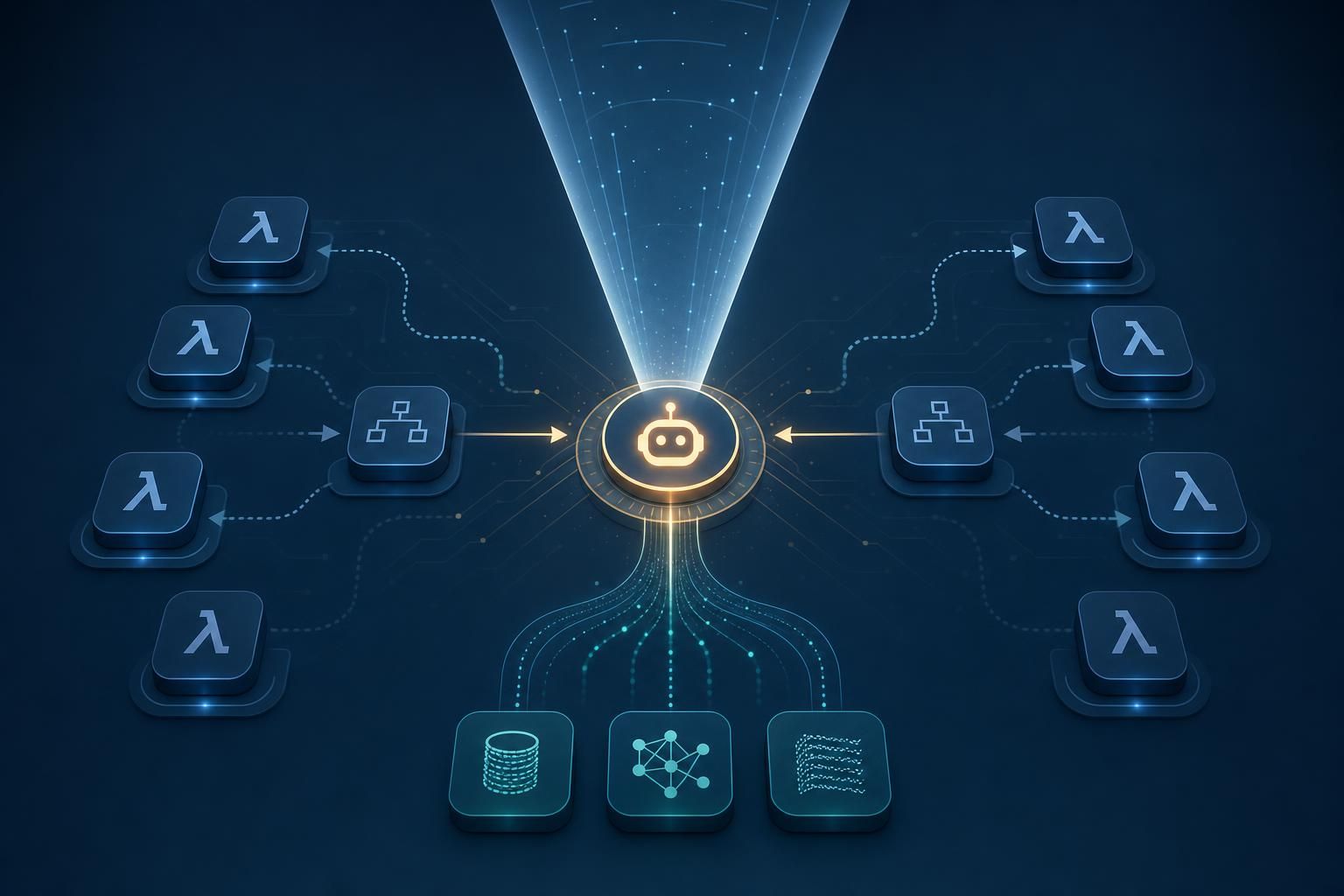
Capella iQ runs inside Couchbase’s AWS control plane across two Regions, with the main EKS footprint in us-east-1 and a failover presence in us-west-2. Requests enter through a cp-api pod, which orchestrates inference calls and sends Bedrock traffic through a VPC interface endpoint rather than exposing model access directly from the public internet.
That matters because the request path is split between application logic and model invocation. The cp-internal-api pod handles internal service-to-service communication and routing decisions, while cp-ns manages namespace-level configuration such as model vendor settings, tenant overrides, and organization preferences. In practice, that gives Couchbase a place to centralize policy without hardwiring a single FM provider into the developer assistant.
The architecture also avoids depending on pre-provisioned model capacity. For an assistant that has to survive bursty developer traffic, that is the right bias: let the application layer absorb variability, and let Bedrock handle model-side elasticity.
Couchbase’s stated goal was flexibility, resilience, and customer alignment. Those are not abstract requirements here; they map to concrete deployment constraints.
A model-agnostic architecture lets them swap or route between providers when one model is unavailable, expensive, or a poor fit for a particular task. That is especially relevant for a database assistant, where the workload is not uniform. Query generation, index recommendations, and multi-turn conversational support can have different latency, quality, and prompt-shaping requirements. A single-model design tends to leak its weaknesses into every feature.
The more important point is that model choice becomes a runtime decision instead of a release-engineering decision. If one tenant wants a specific vendor, or if a regional outage affects one path, routing logic can enforce the policy without changing the assistant surface area. That is the kind of operational decoupling production LLM apps need.
Couchbase uses Anthropic’s Claude family through Amazon Bedrock for Capella iQ. That fit is straightforward for the product shape: the assistant is conversational, multi-turn, and interactive, and Bedrock’s Claude Messages API is designed for that style of workflow.
For an ML engineer evaluating this setup, the key question is not whether Claude can chat. It is whether the assistant can reliably transform a developer intent into database actions under production constraints. Capella iQ’s job includes generating queries, recommending indexes, and maintaining conversational context while staying responsive enough to be useful inside the developer workflow.
Bedrock gives Couchbase a managed path to Claude without building its own model-serving substrate. That simplifies capacity management and reduces the operational surface area, while keeping the application architecture free to incorporate additional foundation-model providers later.
This design is a trade: more internal routing logic in exchange for less vendor lock-in and better fault tolerance. That trade is usually worth it once an LLM feature becomes core to the product rather than a side experiment.
The risk is that model selection logic can become another hidden dependency. If routing rules are poorly tuned, you can end up with inconsistent behavior across tenants, hard-to-debug latency spikes, or subtle quality regressions when traffic shifts between providers. The architecture Couchbase describes acknowledges that risk by separating internal API handling, namespace configuration, and external inference calls into distinct components.
For teams building similar systems, the lesson is simple: if the assistant is going to sit on a critical path, treat model access like any other production dependency. Put policy in one place, keep provider-specific code behind an internal interface, and design for Region-level failure from the start. Couchbase’s Capella iQ setup is a solid example of that pattern.